Life or Death in a Clove
Updated: Sep 3
Introduction
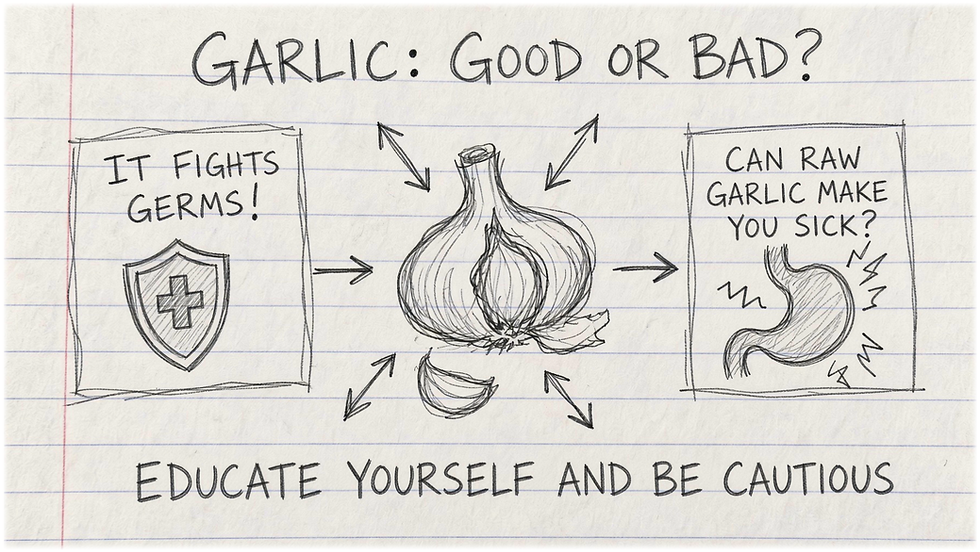
Before you dive in, consider this your official, legally unbinding advisory: the harmless-looking garlic bulb resting on your kitchen counter is not a passive vegetable; it is a volatile, dual-purpose weapon system. Depending on how you handle it, this unassuming little clump of soil-encrusted cloves is either a microscopic bio-shield ready to wage chemical warfare on your behalf, or a low-rent chemical explosive capable of leaving you single, covered in sulfurous sweat, or—if mixed improperly with oil and left on the counter—vaguely paralyzed in an intensive care unit. Welcome to the surprisingly unhinged world of allium chemistry. Here is everything you need to know about the science, the wonder, and the actual criminal case files of nature’s favorite two-part bomb.
Is Raw garlic a tiny pharmacy… or a tiny crime scene?
Have you ever crushed a clove and felt that sharp, almost electric sting in your nose? That is not “flavor.” That is a plant going to war.
Garlic does not exist to season your pasta. It exists because, for millions of years, insects, fungi, and microbes have been trying to eat it. The plant’s answer is one of the most elegant chemical ambushes in the kitchen: a two-part bomb that only detonates when the clove is wounded.
So the question is not merely “is raw garlic healthy?” The question is: what happens when you swallow the bomb before it has finished exploding—and what happens when you cook it first?
Can it save you? Can it harm you? Can it, in rare and very specific conditions, kill you?
Let’s walk through the science, the wonder, and the actual case files.
The ten-second miracle (and why heat ruins the trick)
Inside an intact clove, two ingredients live in separate rooms:
Alliin, a quiet sulfur compound
Alliinase, the enzyme that waits like a sleeper agent
Crush, chop, mince, or chew the clove, and the walls break. Within 10 to 60 seconds, alliinase converts alliin into allicin—the unstable, pungent molecule that makes raw garlic smell like a science experiment and behave like one.
Allicin is not a vitamin you store. It is a short-lived reactive sulfur species. It attacks thiol groups in proteins. That is why it can harass bacteria, fungi, and some parasites in a petri dish. It is also why it does not last. Heat above about 167°F (75°C) degrades it quickly; prolonged cooking finishes the job. Microwave a crushed clove for about a minute and the allicin pathway barely starts.
The cook’s hack that actually has data behind it: crush or mince the garlic, then let it sit about 10 minutes before it hits the pan. The enzyme does its work while it is still alive. Heat then destroys leftover enzyme, but some of the useful breakdown products are already there. You do not get “raw garlic benefits,” but you do not get zero, either.
One or two cloves a day is the range most nutrition sources treat as a food dose, not a medical protocol. You do not need a whole bulb unless you enjoy social isolation.
What raw garlic might actually do for you
Here is where honesty matters more than headlines.
Human trials of raw garlic and garlic preparations have shown modest, real effects—not miracles:
Improved blood lipids in some studies (total cholesterol, triglycerides, sometimes LDL down and HDL up)
Small drops in blood pressure in people who already have hypertension
Better fibrinolytic activity (the blood’s ability to dissolve clots)
Modest improvements in fasting glucose and, in pooled analyses of garlic products, HbA1c
Higher activity of antioxidant enzymes such as SOD, catalase, and glutathione peroxidase
Observational links with better metabolic markers and, in some populations, lower reported risk of certain cancers—though large reviews from groups like the Linus Pauling Institute are more cautious: diet studies have not clearly proven that high garlic intake prevents human cancer
Allicin itself is almost never found intact in your blood after you eat garlic. It falls apart into a family of sulfur metabolites—diallyl disulfide, diallyl trisulfide, ajoene, allyl methyl sulfide (the one that leaves on your breath and, inconveniently, your skin). Those metabolites are the travelers. The clove is the airport.
Wonder, if you want it: allyl methyl sulfide is volatile enough to leave through your lungs and your pores. That is why garlic breath is not just a mouth problem. You become a low-grade sulfur weather system. Evolution did not design that for date night. It designed it so predators and microbes would think twice.
Fun question for the table: if a plant can change the chemistry of your sweat, what else is your dinner doing that you cannot smell?
The case for cooking it
Cooking is not the villain in this story. It is a different pharmacy.
Heat knocks out alliinase, so you lose most of the allicin burst. What you keep:
Other organosulfur compounds that are more heat-stable
A gentler flavor that people actually eat in useful amounts
Far less assault on the stomach, esophagus, and social life
A food safety step that kills vegetative bacteria (the living, multiplying kind—not the armored spores)
Public-health guidance is straightforward: wash produce, and cook garlic to a safe internal temperature. 165°F (74°C) for at least 30 seconds is enough to eliminate ordinary vegetative pathogens such as Salmonella, E. coli, and Listeria. That is kitchen hygiene, not garlic mysticism.
Cooked garlic still belongs in a cardiometabolic pattern of eating. It just is not the same molecule as a raw, rested crush. Different tools. Same plant.
Ask yourself: do you want the sharpest possible chemistry, or the version you will happily eat four nights a week without regretting it at 2 a.m.?
So… can eating raw garlic kill you?
A raw clove from a healthy bulb, chewed or minced into dinner, is extremely unlikely to kill a healthy adult.
That sentence needs a twin:
The way people store garlic—especially in oil—has killed and paralyzed people.
Those two facts can live in the same kitchen.
1. The surface of a bulb is not sterile
Like all fresh produce pulled from soil, raw garlic can carry surface microbes: ordinary soil organisms, and sometimes spores of Clostridium botulinum, plus the usual suspects—Salmonella, E. coli, Listeria. Spores are dormant armor. They are not the toxin. They become dangerous only when they wake up, grow, and manufacture botulinum neurotoxin in the right conditions.
On a raw clove sitting in air, those conditions are usually missing. Oxygen is present. The clove is not a sealed, low-acid, room-temperature swamp. Eating a washed raw clove is not the same as incubating one.
Wash it. That is not folklore. That is produce safety.
2. Garlic in oil is a different planet
Drop chopped garlic into oil and you invent a tiny anaerobic world:
Garlic is a low-acid food (pH typically above 4.6)
Oil blocks oxygen
Room temperature is a spa for the wrong bacteria
The toxin does not reliably change the taste or smell
University of Georgia work and USDA/FSIS guidance are blunt: garlic-in-oil left at room temperature can support botulism. Make it fresh. Refrigerate at 40°F (4°C) or below. Use it quickly—guidance clusters around 3 to 7 days, with some extensions saying within 4 days as a conservative home rule—or freeze it. Commercial jars are a different product: after outbreaks, the FDA required acidifiers or other inhibitors in shelf-stable garlic-in-oil. Your mason jar on the counter is not that product.
Botulinum toxin is among the most potent poisons known. It does not give you “food poisoning tummy.” It unplugs nerves. First nausea and dizziness, then double vision, drooping lids, dry mouth, trouble speaking and swallowing, then the muscles that pull air into your lungs. Death, when it happens, is usually respiratory failure. Antitoxin exists. Time matters.
Real outbreaks, not internet legends
These are not thought experiments.
1985, Vancouver restaurant: commercial chopped garlic in soybean oil. Investigators eventually tied dozens of cases (often cited as 36) of type B botulism to the product. Illness was sometimes mild and slow. People were misdiagnosed with myasthenia gravis, psychiatric disease, even stroke. Some needed ventilators. The garlic still looked and smelled fine.
1989, New York: three people ate garlic bread made with a garlic-in-oil mix stored warm. Leftover oil had a pH of 5.7 and high levels of type A toxin and organisms. That episode helped push the FDA to demand acidification of commercial garlic-in-oil.
1999, Florida: a mother and adult daughter hospitalized after home-bottled garlic oil given as a gift. A neighbor had not acidified it or kept it cold. Three people ill.
2003, Denmark: a healthy 38-year-old developed botulism after eating about four cloves from a ready-to-eat garlic-in-chili-oil dressing.
2024, France: several people needed emergency care after a wild-garlic pesto/sauce; botulism suspected, the same anaerobic-oil logic.
Foodborne botulism in the United States is rare in absolute numbers—often on the order of tens of cases a year, not thousands—and most are still home-canned low-acid foods. Garlic oil is a recurring supporting actor, not the main villain every year. Rarity is not the same as mildness. One bad jar is a neurological emergency.
Question worth taping to the fridge: if the food can look perfect and still contain a toxin that stops breathing, will you trust “it smelled fine”?
Other ways raw garlic can punch back (usually not fatal)
Death is the wrong headline for most kitchen garlic. Misery is more common.
The gut. Raw garlic is rich in fructans. In people with IBS or FODMAP sensitivity, that means gas, bloating, cramps, urgency. Even without IBS, a big raw dose can irritate the stomach lining. Heartburn is a frequent complaint: sulfur compounds can relax the lower esophageal sphincter and nudge acid production. Cooked is often kinder.
The breath and the aura. Allyl methyl sulfide does not care about your meeting. Parsley is a charming myth. Time is the real mouthwash.
The skin and mouth. Crushed raw garlic used as a poultice—on a wart, a cough, a sore wrist—has caused documented chemical burns, often second-degree. A systematic review found 39 published patients. Infants have been burned when well-meaning adults taped cloves to skin. Do not use garlic as a bandage.
The blood. Garlic can inhibit platelet aggregation. In food amounts this is usually a footnote. In “I eat two whole bulbs a day” amounts, clinicians have reported bleeding risk and at least one case of iron-deficiency anemia attributed to heavy raw intake. Stop high-dose garlic 1–2 weeks before surgery. If you take warfarin, aspirin, or other anticoagulants, this is a doctor conversation, not a blog conversation.
The immune system’s overreaction. Garlic allergy is uncommon. Anaphylaxis to raw garlic, with tolerance of cooked garlic, has been documented—heat can smash some of the allergenic proteins. Rare is not imaginary.
The animal data you should not copy. Very high doses have caused hemolytic anemia in rats, dogs, and even bearded dragons fed wild garlic. That is toxicology, not a smoothie recipe.
The identity crisis in the woods. Foragers sometimes confuse wild garlic (Allium ursinum) with autumn crocus (Colchicum autumnale). That is colchicine poisoning, multi-organ failure, and a different article. Know your leaves.
Raw vs cooked: the honest scorecard
Raw (crushed, rested) | Cooked | |
Allicin burst | Highest, if you wait ~10 minutes after crushing | Mostly lost; some pre-formed products remain if you rest first |
Antimicrobial punch in the clove | Strongest | Weaker |
Cardiometabolic signals in trials | Present, modest | Also present via other sulfur compounds and the pattern of eating |
Stomach / reflux / FODMAP peace | Worse for many people | Better for many people |
Everyday safety of the clove itself | Wash it; ordinary raw use is low risk | Heat kills vegetative pathogens |
Botulism risk | Not from a fresh clove in air | Not from sautéed garlic in a pan. High if raw garlic sits in oil, warm and unacidified |
Social side effects | Legendary | Manageable |
Will you actually eat it often? | Only if you like the burn | Usually yes |
Neither column is “life.” Neither column is automatically “death.” The lethal column is storage, not the raw-versus-cooked debate people argue about on the internet.
How to keep the wonder and skip the ER
Buy firm bulbs. No soft spots, no sprouting slime, no mystery jar from a gift basket that has been living in a cupboard since July.
Wash. Soil is not a seasoning.
For maximum chemistry: crush or mince, rest 10 minutes, eat raw in small amounts—chimichurri, salsa cruda, yogurt sauce, a clove mashed into honey if your stomach allows it.
For maximum dinner: rest it, then cook it briefly. Add it late. Do not incinerate it into bitterness.
For garlic oil: make a little. Refrigerate immediately. Use within a few days (think 4 days if you want the conservative home rule, up to 7 if you follow USDA’s refrigerated window). Freeze extra. Or acidify properly and still refrigerate. Never leave homemade garlic oil on the counter “to infuse.”
Do not tape garlic to children, pets, or your own skin.
Do not treat two raw bulbs a day as a personality.
If you ever get double vision, drooping eyelids, or trouble swallowing after a preserved or oily garlic dish—that is not heartburn. That is an emergency.
The verdict, without the incense
Is raw garlic “worth it”?
If you tolerate it, yes—as food, in clove-sized doses, with a 10-minute rest after crushing. The benefits in human studies are real and modest: lipids, blood pressure, redox enzymes, a little glucose help. They are not a substitute for medication, sleep, or not smoking. Allicin is a beautiful, unstable weapon. Your body meets its descendants, not the intact molecule.
Can eating raw garlic kill you?
Almost never, if “raw garlic” means a washed clove in tonight’s salad.
Yes, in principle and in documented history, if “raw garlic” means a low-acid clove sealed in oil, stored warm, and eaten days later when it still looks innocent.
That is the strange symmetry of this plant. The same sulfur chemistry that makes garlic a folk hero also makes it harsh on tissue. The same soil that grows a bulb can donate a spore. The same oil that carries aroma can smother oxygen until the wrong microbe writes a toxin.
Life and death, in this case, are not opposites on a wellness poster. They are two settings on the same switch: time, temperature, oxygen, and dose.
So—will you crush a clove and wait ten minutes like a chemist? Or will you keep a pretty bottle of garlic oil on the counter because it looks like a magazine?
The plant already answered. It built a bomb that only goes off when something breaks the clove.
The only remaining question is whether you are the gardener… or the jar.
In Summary...
So, where does that leave our volatile little kitchen hand grenade?
Ultimately, garlic is neither a magical, cure-all elixir nor a localized hazard that belongs in a biohazard bin. It is simply one of nature’s most aggressive evolutionary triumphs—a microscopic pharmacy, a sulfurous chemical weapon, and an exquisite culinary asset all rolled into one papery skin.
If you respect the chemistry, it will reward you. Crush it, wait ten minutes like a rogue lab tech, and enjoy the sharp, biological firepower of a plant that fought for millions of years to earn its place in your dinner. Cook it gently, and it softens into a heartwarming baseline for human comfort. But ignore the physics—smother it in oil, leave it in the dark, and let time do the rest—and you turn a harmless bulb into an oxygen-starved, nerve-shattering biological trap.
The choice, as always, is yours. You can treat garlic like the volatile two-part weapon it is and cook with a little reverence, or you can leave a pretty, unacidified jar sitting on your warm counter because it looks nice for social media.
Just remember: the plant already built the bomb. It’s entirely up to you how it detonates.


