Garlic Glory: Transforming Your Yard into an Edible Wonderland


Garlic Glory: Transforming Your Yard into an Edible Wonderland with Hardneck, Softneck, and Elephant Varieties.
Hey there, green thumbs and flavor fanatics! Imagine stepping into your backyard not just for a breath of fresh air, but for a harvest of zesty, homegrown goodness that doubles as eye candy. That's the magic of edible landscaping—blending beauty with bounty in a way that's as smart as it is scrumptious. In a world where climate quirks are throwing curveballs at our gardens, this trend is exploding in popularity, turning ordinary lawns into productive paradises. And today, we're zooming in on a superstar of the edimental scene: garlic! Not just any garlic, but the dynamic trio of hardneck, softneck, and the quirky elephant garlic (which, spoiler alert, isn't even true garlic). Let us explore garlic. By the end, you'll be itching to plant your own garlic empire.
What on Earth Are Edimentals and Edible Landscaping?
Let's start with the basics—because who doesn't love a good origin story? Edible landscaping, or "edimentals" for short, is the art of weaving food-producing plants into your ornamental garden design. Think berry bushes as borders, fruit trees as focal points, and herbs like garlic tucked among flowers. It's not new—ancient civilizations did it for survival—but it's having a renaissance amid rising food costs and eco-awareness.
Scientifically speaking, this approach boosts biodiversity by creating habitats for pollinators and beneficial insects, while reducing water waste and chemical use. Studies show that diverse plantings improve soil health through natural nutrient cycling and pest resistance, cutting down on monoculture woes like disease outbreaks. Plus, it's a win for your health: fresh edibles mean more vitamins on your plate without the carbon footprint of store-bought produce. Fun fact: Your garden could repel vampires and pests—garlic's sulfur compounds act as natural bug deterrents, making it a good companion plant for roses, tomatoes, and more. Who knew sustainability could taste so garlicky? Ditch your green grass.
Why Garlic? The Clove That Conquers All
Garlic (Allium sativum) isn't just a kitchen staple—it's a botanical powerhouse with roots (pun intended) tracing back 5,000 years to Central Asia. Egyptians fed it to pyramid builders for stamina, and ancient Greeks used it as a performance enhancer. Fast-forward to today, and science backs the hype: Garlic's active compound, allicin, forms when cloves are crushed, delivering antimicrobial, antifungal, and antioxidant punch. Human studies link it to lower blood pressure, reduced cholesterol, and even cancer-fighting potential by boosting immune function and detoxifying heavy metals. Nutritionally, it's loaded with vitamins B and C, manganese, and selenium—perfect for warding off colds or just feeling fabulous. In the garden, garlic shines as a low-maintenance hero. It repels aphids, Japanese beetles, and even deer with its pungent aroma, while enriching soil microbes for better plant growth. And let's be real: Nothing says "I'm a gardening boss" like braiding your own softneck garlic harvest. But not all garlic is created equal—enter our three varieties, each with its own superpowers.
Meet the Garlic Gang: Hardneck, Softneck, and Elephant
Picture this: Garlic varieties are like superhero siblings—similar DNA, but wildly different skills. Botanically, true garlic falls under Allium sativum, split into hardneck (var. ophioscorodon) and softneck types. Elephant garlic? It's actually a leek cousin (Allium ampeloprasum), but we'll include it for its giant, fun-factor vibes.
Hardneck Garlic: The Bold, Cold-Hardy Warrior
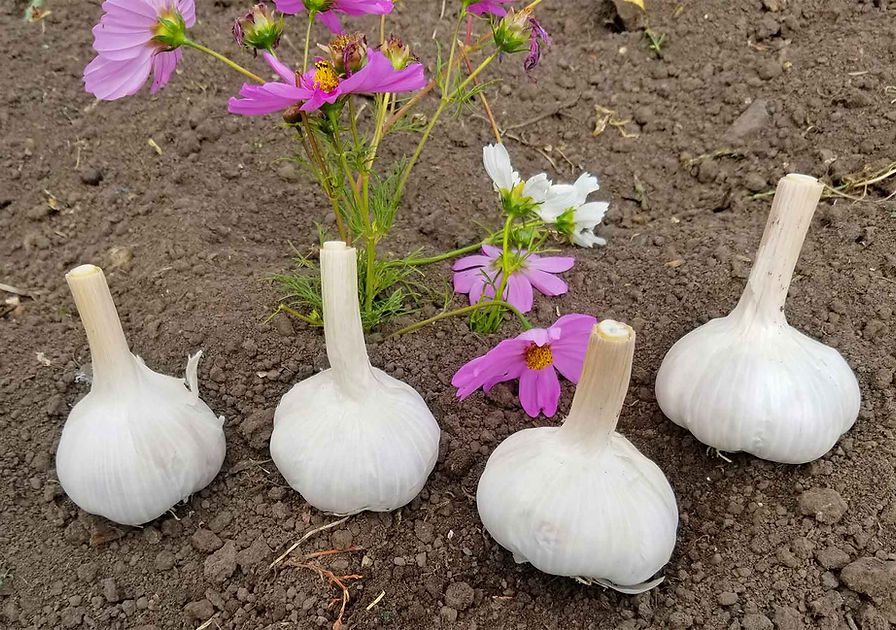
Here at our GROeat.com farm in Bozeman, Montana, we grow Hardneck garlic. Hardnecks are the rockstars of the garlic world—think fewer but larger cloves (4-12 per bulb) circling a stiff, woody central stem that shoots up a curly scape (flower stalk) in spring. These scapes aren't just pretty; they're edible gold—snip 'em for stir-fries or pesto, and your bulbs will grow even bigger! Flavor-wise, hardnecks pack a punch: spicy, complex, and aromatic, thanks to higher allicin levels.
Ideal for colder climates (USDA zones 3-6), they thrive with a winter chill to "vernalize" and form bulbs. Plant in fall: Dig 3-inch holes, pointy end up, 6 inches apart in full sun and well-drained, compost-rich soil. Pay $50 for a soil test. It is worth every cent. Mulch heavily to protect from frost. Harvest in summer when leaves yellow. Fun twist: Varieties like 'Porcelain' or 'Purple Stripe' add colorful stripes to your landscape—plant them among perennials for a pop of purple drama.
Softneck Garlic: The Mild, whimpish garlic.
If hardnecks are the divas, softnecks are the reliable sidekicks. No central stem here—just layers of 10-20 smaller cloves wrapped in papery skins, with flexible necks perfect for braiding into kitchen art. Their flavor? Subtler, and mild making them grocery store staples like 'California Early'.
Suited for milder winters (zones 6-9). Growing tips mirror hardnecks: Fall planting, fertile soil, but they're more forgiving in heat. Rotate crops every 5-7 years to dodge diseases, and fertilize with nitrogen-rich compost for plump bulbs. Pro tip: Edge your flower beds with softnecks—their strappy leaves blend seamlessly with grasses.
Elephant Garlic: The Gentle Giant (That's Actually a Leek)
Ah, elephant garlic—the oversized underdog! Bulbs can weigh a pound with 4-6 massive cloves, but it's milder, almost onion-like in taste, since it's a leek variety. Less pungent, it's great for roasting whole or for garlic newbies. Grow it like true garlic: Plant big cloves deeper (4-6 inches) in rich soil, and watch it tower up to 5 feet with showy flower heads. It's hardy in zones 5-10 and loves space—perfect as a statement plant in your edible border. Bonus: Its blooms attract bees, supercharging your garden's pollination party.
Designing Your Garlic-Powered Edible Oasis
Ready to get dirty? Integrate these varieties for maximum impact. Plant hardnecks in raised beds with companions like strawberries (they deter slugs together). Softenecks can fringe pathways, while elephant garlic anchors corners for vertical interest. Avoid planting near beans or peas—they don't play nice due to garlic's allelopathic compounds. Water wisely (deep but infrequently), and get rid of those weeds. Scientifically, garlic's root exudates can enhance neighboring plants' resilience to stress. For fun, host a "garlic gala" harvest party—braid softnecks, grill elephant cloves, and whip up scape smoothies.
The Final Clove: Plant Power Awaits!
There you have it: Garlic isn't just food; it's a gateway to a thriving, tasty landscape that nourishes body, soul, and soil. In this era of edible revolutions, embracing hardneck's boldness, softneck's reliability, and elephant's whimsy can turn your yard into a sustainable sanctuary. Buy seed garlic, channel your inner botanist Extraordinaire, and plant today—your future self (and taste buds) will thank you. What's stopping you? Dig in, and let the garlic adventures begin! Be sure to take your shoes off and get your toes dirty. Have fun.


Vegetable Garden, or the Perfect Lawn: A Glory Story
It was a chaotic tangle of yellowed crabgrass, aggressive morning glory vines, and the skeletal remains of a forgotten lilac hedge, all dwarfed by a vast, silent 150-year-old Victorian home. The house, beautiful but bruised, was in Bozeman’s historic district. It had an imperious presence, and the scent of its strong, ancient timber was a stark contrast to the sterilized air of Manhattan, New York she’d fled. Manhattan serves as New York City's economic and administrative center and has been described as the cultural, financial, media, and entertainment capital.
At forty, her blonde hair was a desperate mess of highlights and new-growth brown, and her hands were already showing the first angry blisters of a woman who'd never held anything heavier than a champagne flute. She'd traded her six-figure salary, the vertigo of Wall Street, and the relentless, bloodless rhythm of a New York life for this postage-stamp of property, a leaky roof, and the fierce, judgmental gaze of her new neighbors.
It started with the soup, but the real fire began with the betrayal.
The Ghost of Europa and the Garlic Epiphany
The memory was of her Grandma Angela, a woman with hands like weathered oak who had immigrated from Europe in the early 1900s, bringing nothing but a suitcase and a singular, fierce love for garlic. Angela believed garlic was the cure for everything—sadness, sickness, and the general bewilderment of being alive.
"Garlic is the breath of God, Alexis," she'd say, her accent thick as molasses. She’d crush the cloves with a rhythmic thud-thud-thud that echoed through Alexis's childhood.
In the Manhattan, New York bistro, the peasant-style garlic soup’s heat stinging her eyes, she didn't just see the absurdity of Wall Street; she saw the lie of her whole existence. Her ex-fiancé, a hedge fund manager, had told her, “You were never meant for anything dirty, Alexis. Your job is to be beautiful, well-read, and well-funded.” The words, meant as a compliment, now felt like a curse. The immaculate silk dress she wore was a uniform of her captivity.
The moment the waiter placed the bowl of peasant-style garlic soup before her in the pristine silence of the Upper East Side bistro, Alexis inhaled a scent that cleaved her life in two. That single, honest breath—garlic, rich stock, and love—was the ghost of her Grandma Angela, a woman who crushed cloves with the power of a prayer and believed the cure for the world's madness lay in the pungent strength of a bulb. A choked, involuntary sob caught in Alexis's throat as she tasted it, realizing the paper-thin transactions of Wall Street had left her forty-year-old soul completely starved; she was weeping for the sheer, brutal fact that for a decade, she'd been living on air while her ancestors had understood that true wealth grows from the dirt. She suddenly caught sight of her reflection in a nearby silver spoon, saw the immaculate, ridiculous silk dress, and let out a frantic, wet gasp of a laugh: "My God," she choked out to the empty table, "I’ve become a six-figure idiot who forgot how to feed herself!
“I hate this,” she whispered, the words tasting metallic, like a gold coin. “I hate my job. I hate being clean.”
That night, she listed her apartment, emptied her bank account of all but a sensible amount, and, in a fit of righteous fury, she donated the silk dress to Goodwill (letting it benefit others was incredibly therapeutic). The next morning, she pointed her sleek, black BMW west. Bozeman was a place to get dirty.
Million-Dollar Homes
The first three Bozeman realtors Alexis met were all named Chad, wore vests over plaid shirts, and drove massive pickup trucks that smelled faintly of artificial pine and commission. She spent three agonizing weeks driving past $800,000 condos that looked like ski resort locker rooms and million-dollar “modern farmhouses” with no actual farm, thinking, And I thought New York was expensive. Every property was either flawless and sterile, lacking the soul her Grandma Angela demanded, or it was a teardown on a postage stamp of land. The search felt like a cruel joke: she’d traded her financial freedom for the promise of Montana roots, but the price of entry was another layer of gilded, soulless perfection. One afternoon, after a Chad showed her a $1.2 million house with an HOA that banned vegetable gardens, she realized the crushing truth: she may have to exchange a Manhattan cage for a Bozeman one, and the neighbors would likely be too busy paying their mortgages to ever say hello.
Then, just as the last Chad was trying to upsell her on a property with a regulation putting green, Alexis found it tucked away on a leafy, inconspicuous street in the historic district: a two-story Victorian with deep eaves and peeling paint, the kind of house that had good bones and a comforting smell of dust and old books, instantly reminding her of Grandma Angela’s European apartment. It sat solidly on a 41 acre lot that was a delightful mess of overgrown weeds and a few towering, ancient cottonwoods that whispered secrets in the breeze. Best of all, a tiny, gurgling irrigation ditch, or stream as she immediately dubbed it, ran along the back fence, promising endless water. Looking out at the sun-dappled, weed-choked yard—not a manicured carpet of turf in sight—Alexis didn't see ruin; she saw a vast, fertile canvas of black earth, waiting for her to paint it with the vivid greens and pungent whites of her glorious garlic mission.
The Drama of the Dirt and the Man on Her Steps
The 1/4 acre lot was a battleground. Her neighbors, veterans of the Historic District Homeowners Association, had a singular obsession: the Perfect Lawn. Their yards were surgically green carpets, vast, thirsty symbols of status that made Alexis’s weedy, messy plot an eyesore.
She committed a dramatic act of self-flagellation: she traded the BMW for a beat-up pickup truck, a gleaming TREK mountain bike, and enough bags of compost to choke a horse. Her focus narrowed to a singular, pungent, holy mission: transforming the front yard into a glorious, mounded, black-earth garden of garlic.
She got a dog, a gangly, caramel-colored mutt with soulful eyes, and named him Cassidy.
She started digging. The soil, compacted and choked with decades of neglect, fought her. Every swing of the mattock was a punishment for her past. She toiled for weeks, her back in constant agony. One crisp October day, as she was spreading a desperate layer of winter mulch over the first garlic cloves, the neighbor's wife, a perfectly coiffed woman named Carol, walked past with a sneer.
"It's a disgrace, dear," Carol drawled. "Your garden... it's just so messy. It ruins the curb appeal. Are you even going to have a lawn?"
Alexis stood up, dirt clinging to her face like war paint. "No, Carol," she replied, her voice low and steady. "I'm going to have food. I suggest you look up from your turf once in a while."
The Clash and the Kindness
Just as the drama with Carol reached a boiling point, a dark-green Toyota pickup pulled up. A man unfolded himself from the cab. He looked formidable, with kind, blue-green eyes, and a full, goatee beard. He carried a box of old tools.
“You the woman who’s declared war on the crabgrass?” he asked, a slow smile spreading across his face. “Name’s Alex. I live two blocks over. The Historic Preservation Board sent me. They’re technically not happy about the lack of turf, but I’m here because your soil pH is probably a mess, and your porch needs shoring up before winter. I'm a contractor."
Alexis wiped a smudge of dirt from her cheek. “Name is Alexis. And thank you. I need to know my NPK levels before I plant. And I’m going to have garlic. Only garlic.”
Alex knelt by her patch, his own hands scarred and competent. “Porcelain or Purple Stripe Hardnecks? This historic soil needs a good, cold-hardy warrior.”
Alexis’s heart leaped. He spoke the language of the soil, the secret tongue of the Allium sativum. “Porcelain. And the scapes are phenomenal for pesto.”
“Smart woman,” Alex chuckled, pulling out a testing kit. “Look, Carol and the board are worried about property values. But the truth is, this house has been starving for kindness for 20 years. You’re finally feeding it.”
They talked for hours that day—about winter mulch, the idiocy of chemically-fed lawns, and the pure, glorious power of getting your toes dirty. Alex didn't speak of New York, but he did speak of his own failed marriage—a life spent trying to fit into a mold that wasn't his. Lesson learned: They were both refugees from a perfect, but false, world.
Seed Garlic from GROeat Farm.
It turns out the antidote to a million-dollar salary wasn't a bank account withdrawal; it was a bike ride up to GROeat Farm near Hyalite Canyon. Alexis, humming a riotous mix of Wall Street anthems and country music, felt the financial pressure dissolve the moment she got off her Trek, and was hit by the scent of pure, pungent potential. She ended up talking to the owner for an hour about the superiority of Porcelain Hardneck, walking away with four pounds of seed garlic, a new, intense focus, and two jars of their legendary Million Dollar Garlic Morsels. That evening, she made a simple spaghetti dinner for Alex, generously folding those ridiculously flavorful morsels into the sauce. They ate the whole pot, their smiles so wide and their breath so gloriously, aggressively garlicky that they had to converse in muffled laughs and meaningful glances, their shared, wonderful stink cementing the fact that they'd both finally found their most honest, richest life.
The First Harvest and the Love
The true tears came on the day of the first great Garlic Harvest.
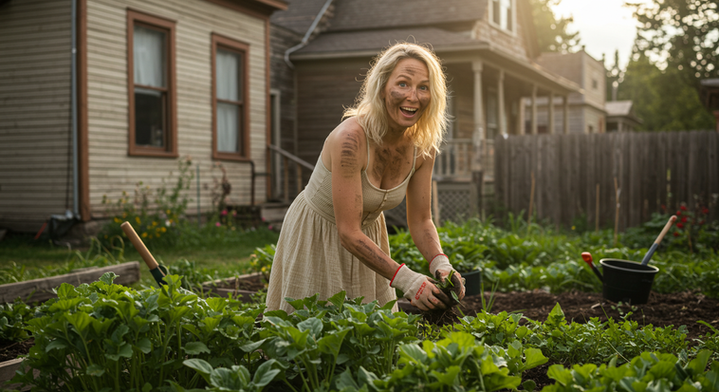
It was a brilliant July morning. Alexis and Alex, with Cassidy weaving excitedly around their ankles, dug the bulbs. Not a paper-thin softneck, but fat, heavy, perfectly wrapped bulbs of Porcelain Hardneck. They laid them out to cure on a tarp on the porch, the air thick with that ancient, sacred, pungent aroma.
Alexis reached down and picked up a gigantic, beautiful bulb. It was heavier than she imagined. The weight of the bulb was the weight of her life, now right-side up. She had traded the slick pavement for the pungent earth, and the empty dollars for the living bulb.
A sob caught in her throat, a sound torn from the deepest part of her soul, the part that had been starving for forty years.
“Alex,” she choked out, her face crumpling. “It’s… it's real.”
Alex, who had been watching her with quiet adoration, didn't ask what was wrong. He understood that this was not sadness, but the violent release of long-held fear. Kindness is recognizing the true burden. He simply wrapped his arms around her, burying his face in her sun-warmed hair, and held her as she wept into his overalls.
As Alexis sobbed, clutching the perfect bulb, Alex whispered, his voice thick with emotion, “You know, that old Hardneck is the most honest thing you’ll ever grow. It’s exactly what it says it is. And you, Alexis, you are the most honest woman I've ever met.”
He pulled back, his eyes glistening. He leaned in and, right there, in the middle of her tiny patch of Garlic Glory, he whispered into her ear, "I have a contract to fix the porch, but I'd like a lifetime contract for your company. I don't care about a lawn, Alexis. I want a woman who makes things grow."
Alexis, overwhelmed by the perfection of the moment—the garlic, the man, the truth of her life—let out a wild, involuntary cackle that started in her belly and echoed across the historic district.
Alex looked at her, confused but delighted. “What was that?”
“Oh, Alex!” she managed between gasps, clutching her side. “I just realized… my whole life… I've been waiting for a man who smells like garlic!”
The two of them stood in their edible wonderland, the scent of a thousand promised meals in the air, a final, delicious lesson learned: The true historic glory is not a perfect, useless lawn, but a fertile life, lovingly tended, that smells beautifully, wickedly real.
.jpg)
References
-
University of Minnesota Extension. (n.d.). Growing Garlic in Minnesota. Retrieved from https://extension.umn.edu/vegetables/growing-garlic
-
Provides planting instructions for garlic, including depth and spacing requirements.
-
-
Cornell Cooperative Extension. (n.d.). Crop Rotation for Garlic. Retrieved from https://cce.cornell.edu/garlic/crop-rotation
-
Recommends crop rotation practices to prevent soil-borne diseases in garlic cultivation.
-
-
Oregon State University Extension Service. (n.d.). Garlic: Planting and Care. Retrieved from https://extension.oregonstate.edu/gardening/techniques/garlic-planting-care
-
Advises on soil preparation and mulching for garlic in various climates.
-
-
Michigan State University Extension. (n.d.). Hardneck Garlic for Cold Climates. Retrieved from https://www.canr.msu.edu/news/growing_hardneck_garlic
-
Discusses vernalization and cold climate suitability for hardneck garlic.
-
-
University of California Agriculture and Natural Resources. (n.d.). Softneck Garlic in Warm Climates. Retrieved from https://ucanr.edu/sites/gardenweb/Growing_Garlic/
-
Details softneck garlic’s adaptability to milder winters.
-
-
Washington State University Extension. (n.d.). Fertilizing Garlic for Optimal Growth. Retrieved from https://extension.wsu.edu/garlic/fertilizing
-
Recommends nitrogen-rich fertilization for garlic bulb development.
-
-
University of Wisconsin-Madison Extension. (n.d.). Soil Testing for Gardeners. Retrieved from https://hort.extension.wisc.edu/articles/soil-testing/
-
Emphasizes the importance of soil testing for optimal garlic growth.
-
-
National Institutes of Health. (2023). Garlic and Cardiovascular Health. Retrieved from https://www.ncbi.nlm.nih.gov/pmc/articles/PMC6966103/
-
Reviews studies on garlic’s effects on blood pressure and cholesterol.
-