Buy Garlic
GARLIC
Grown with Love and Kindness.



We don’t have any products to show here right now.






"Popeye, with his odd accent and large forearms, used spinach to great effect, a sort of anti-Kryptonite. It gave him his strength. It's been said that when he was not making movies, and not on camera, he ate more garlic than spinach." - Jere Folgert


The Glorious, Stinky Truth About Garlic
Garlic. The very word conjures a scent that says, "Dinner is about to get serious." It’s not just an ingredient; it’s the non-negotiable, culinary superhero in a papery cloak. If your kitchen is well-stocked, somewhere up there with the olive oil and a panicked search for your favorite spatula, is a beautiful head of Allium sativum.
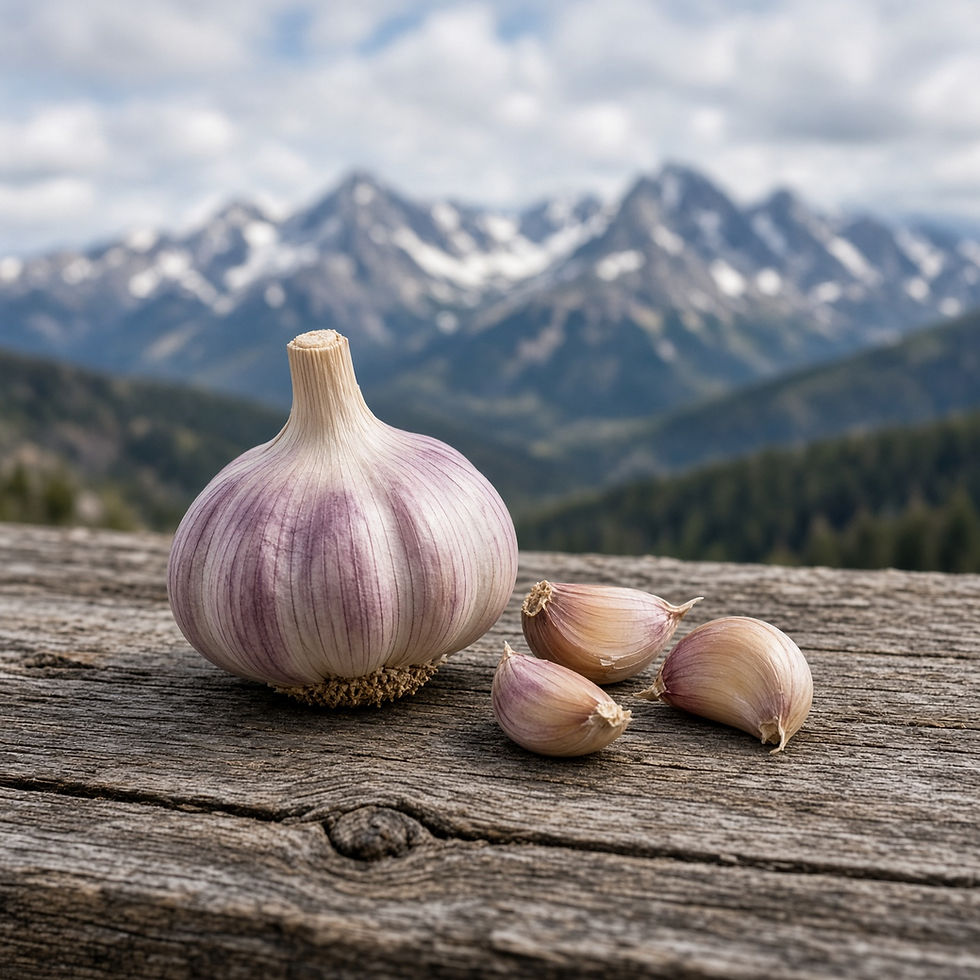
A single garlic bulb (or head) is a tiny, self-contained flavor commune, comprised of individual cloves—each encased in a skin that can range from snowy white to a rather regal purple or mauve. Bite into a raw clove and you get a pungent, fiery WHAM! that screams, "Hey, look at me!" Cook it, however, and this little diva mellows out, transforming into a buttery, creamy dream that is less "shock and awe" and more "velvet smooth jazz." The transformation is all thanks to heat breaking down its potent chemical compounds.
The Science of the Stink (And the Snap!)
Let's talk compounds, baby, because this is where the magic (and the aroma that wards off vampires and dates) happens. When you cut or crush a clove, you damage the cell walls. This releases an enzyme called alliinase, which immediately starts converting a precursor compound, alliin, into the powerful molecule allicin.
-
Fun Fact: Allicin is what gives garlic its characteristic pungency and is the star of the show for most of its reported health benefits. Its half-life in crushed garlic at room temperature is only about 2.5 days, meaning its beneficial compounds are best enjoyed fresh. It's like a fleeting celebrity appearance!
-
More Science: Allicin quickly breaks down into dozens of other beneficial organosulfur compounds. It’s like a chemical family tree with a whole lot of health benefits, touching on your cardiovascular, immune, and inflammatory systems. Basically, your body gives it a gold star.
For the Love of Hardneck
Forget the whimpy stuff. We are devotees of hardneck garlic. Why? Because it’s richer, more complex, and frankly, has more attitude than its softneck cousins. Hardneck varieties typically have a stiffer central stalk and are often prized by gourmet chefs for their superior, nuanced flavor profiles. (Plus, who doesn't like a garlic that stands up straight?)
Nutritional Knockout
Garlic isn't just about the zing; it's a nutritional powerhouse. It’s a genuine source of Manganese, Vitamin B6, and Vitamin C. It's the little bulb that could—and does—delivering a surprising amount of nutritional punch for such a tiny, potent package. When you're trying to achieve a well-rounded, healthy meal plan, studies are increasingly showing potential benefits from regular garlic intake, especially concerning cardiovascular health (hello, lower blood pressure!) and even cancer risk reduction. So, whether you toss it in with your shrimp, roast it whole with your potatoes, or just nibble on a clove to keep your internal engine running smoothly, remember: Garlic is health that tastes good. And just to be clear, we are all about authentic, flavorful hardneck garlic. We are a "Despacito" and "Baby Shark" free zone. Your taste buds deserve better.
-
Sulfur-Containing Amino Acids and Peptides
-
cysteine
-
methionine
-
S-allylcysteine
-
S-allylmercaptocysteine
-
glutathione
-
S-ethyl cysteine (SEC)
-
N-acetyl cysteine (NAC)
-
-
Thiosulfinates
-
allicin
-
allyl sulfinates
-
methyl allyl sulfinates
-
-
Sulfoxides
-
alliin
-
garlicins
-
methiin
-
isoalliin
-
-
Sulfides, Diallyl Sulfides and Polysulfides
-
hydrogen sulfide (H2S)
-
diallyl sulfide (DAS)
-
diallyl disulfide (DADS)
-
diallyl trisulfide (DATS)
-
-
Vinyldithiins
-
1,2-vinyldithiin
-
dehydrovinyldithiins
-
-
Ajoenes
-
E-ajoene
-
Z-ajoene
-
The Garlic Identity Crisis: Why 274 Names Mean (Almost) Nothing
You thought picking a favorite child was hard? Try sorting out the hundreds of garlic varieties available today! Botanically speaking, all the culinary garlics we obsess over are huddled under the single species umbrella: Allium sativum. If you’ve ever opened a seed catalog, you’ve been bombarded with names that sound like characters in an epic fantasy novel: 'Chesnok Red,' 'Montana Zemo,' 'German White,' 'Whiskey Fire'... The list is dizzying. In fact, back in 1903, only three "named" cultivars existed. Fast forward to 2003, and that number exploded to 274! The 20th century might have been rough for crop diversity in general, but garlic was apparently having a party, naming everything in sight.
The DNA Detectives Shut Down the Party
This is where science strides in, wearing a lab coat and a look of mild skepticism. Before 2003, trying to choose a variety felt like throwing darts blindfolded. Then, Dr. Joachim Keller in Germany and Dr. Gayle Volk of the USDA in Colorado—our fearless Garlic DNA Detectives—used DNA analysis to bring order to the madness. And what did they find? A harsh truth wrapped in a papery skin: Many of those hundreds of names are just clones wearing different hats!
The Scientific Mic Drop: DNA analysis revealed that most named varieties are simply regional expressions or renamed clones of a much smaller group of foundational garlics. Imagine finding out your 'German Extra Hardy' is just 'Kyjev' after an overseas flight.
The Ten Commandments of Garlic Classification
The scientific analysis successfully categorized all culinary garlics into ten distinct groups, making life significantly easier for growers and connoisseurs alike. Forget the hundred names, these five are what really matter:
-
Porcelain: Famous for producing massive, easy-to-peel cloves and having a potent, long-lasting flavor. (The reliable heavyweight champ.)
-
Rocambole: The gold standard for flavor, known for being rich, complex, and spicy. Their wrappers are loosely fitted, making them easy to peel. (The gourmand's favorite.)
-
Purple Stripe: Defined by their vivid streaks of purple on the bulb wrappers. They have a subtle sweetness, making them excellent for roasting.
-
Marbled Purple Stripe: A close relative of the Purple Stripe, but with a less intense color and flavor. They tend to have larger cloves.
-
Glazed Purple Stripe: A rare group, known for a bright, almost metallic "glazed" look on their wrapper. They are often very pungent when raw.

"At GroEat Farms, we grow and provide seed garlic and culinary garlic. Our goal is to promote garden and food crop heritage for future generations. We grow a variety of garlic cultivars and share our heirloom seed garlic with growers, cooks and chefs across the United States. We are motivated by a curiosity and for the sensuous world and its splendor of colors, textures and flavors. Discernment for excellent garlic begins at the level of the seed - and quality seed garlic is paramount to garlic success. By planting a variety of garlic in your garden, it will be an improvement and lifelong journey that frequently takes side quests. Take this adventurous detour. Know your Farmer. Buy seed garlic from us online or locally. We're here to help." - Jere Folgert, owner GroEat Farm.